What Is the First and Most Important Environmental Context for Babies?
What tin can teachers do to brand the classroom environment more than conducive to children'south learning and evolution?
Page i: Early Childhood Environments
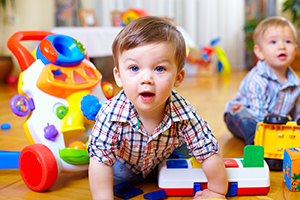 Safe, responsive, and nurturing environments are an important office of supporting the learning and development of infants, toddlers, and preschoolers. Such environments also help to prevent challenging behaviors and serve equally a core component of interventions for infants and young children with identified disabilities. According to the Division for Early Childhood Recommended Practices (December-RP):
"Ecology practices refer to aspects of the space, materials, equipment, routines, and activities that practitioners and families can intentionally alter to back up each child's learning across developmental domains."
Unfortunately, many practitioners are unsure how to create environments that back up their children's learning across dissimilar age groups (e.thou., infants, toddlers, preschoolers) and developmental domains (e.thou., social, communication, cognitive, motor). Well-designed classroom* environments:
- Support responsive caregiving
- Foster independence and feelings of competence in young children
- Encourage staff efficiency
- Promote children's engagement
- Decrease challenging beliefs
- Facilitate appropriate social interactions amidst children
- Provide structure and predictability
Research Shows
Changes in classroom environmental arrangement, such as rearranging furniture, implementing activity schedules, and altering means of providing instructions around routines, have been found to increase the probability of appropriate behaviors and effectively decrease the probability of challenging behaviors.
(Chandler et al., 1999; Dooley, Wilczenski, & Torem, 2001; Martens, Eckert, Bradley, & Ardoin, 1999)
The tabular array beneath describes three interdependent components of early childhood environments.
| Components of Early Babyhood Environments | Definition |
| Concrete surroundings | The overall design and layout of a room, including its learning centers, materials, and furnishings |
| Social environs | The interactions that occur within the classroom between peers, teachers, and family members |
| Temporal environment | The timing, sequence, and length of routines and activities that take place throughout the day |
In club to create an environment conducive to the learning and development of infants, toddlers, and preschoolers, these 3 components must be carefully designed and implemented. Indeed, every attribute of a classroom surround'south design should reflect its program'due south priorities and philosophy. For example, a program that concentrates on improving children'south math skills is likely to emphasize the availability of materials related to numeracy, as well every bit to learning shapes and patterns. Additionally, if this plan's philosophy was Montessori-inspired—that is, it helped students to learn concepts through hands-on work with materials, rather than by traditional direct pedagogy—y'all might wait to see bead bondage to support the teaching of mathematical concepts.
The following pages address these physical, social, and temporal components in more detail.
Listen as Ilene Schwartz discusses how the three components of the environment are intertwined to aid children succeed (time: 2:47).
Ilene Schwartz, PhD
Professor, Special Educational activity
Director, Haring Heart for Research and Grooming in Inclusive Instruction
Academy of Washington

Transcript: Ilene Schwartz, PhD
The environment both sets children up for success and supports that success when it occurs. Children acquire by doing, and so they need environments that have the advisable kinds of materials available for them to demonstrate the wonderful skills that they have, and to learn the skills that they need to learn to be successful in time to come environments. Environments consist of the things in the environments, the people in the environs, and the tone of the environment. So we can have an environment that is supportive because children feel safe to explore and to try things that they're not certain of because they know there'south going to be a supportive adult at that place to assist them if they need the aid.
The three discrete components of a well-designed early babyhood environs—the temporal, social, and physical environments—actually do non stand alone. They're like ingredients in a well-designed recipe. You don't want as well much of one, but the absence of another could potentially ruin the whole recipe. You desire to brand sure that children have admission to a well-designed and challenging physical environment. Things are in the environment that the child with the most challenges in your classroom tin can do independently, and your highest-achieving child is still challenged past something in the environment. Only at the same time, that environment without the warm support of a instructor is limited. You want a social surroundings in which children have positive regard from their instructor and high-quality interactions with their peers. Merely that in isolation is also not enough. The aforementioned goes for a well-designed temporal environs. You want to brand certain that children have the opportunity every day to play outside, to be active, and at the same time to accept opportunities to practice skills such every bit writing and coloring and cutting that will help them be successful in time to come environments.
These 3 kinds of environments are intertwined in a manner that you really tin't accept apart. And you don't want to take apart. They complement each other and they aid children learn to explore and to achieve and to succeed. And that's really all we can inquire from any high-quality early learning environs.
Including Children with Disabilities
A well-designed, rubber, and responsive environs is an essential first footstep in including young children with disabilities in early babyhood settings such as inclusive preschool, Caput Start, and childcare programs. If, notwithstanding, the learning surround does not provide the support necessary to help children with disabilities to succeed, teachers must make changes to maximize their participation in planned activities, interactions, and routines. These intentional changes can be pocket-size and are oftentimes easy to implement, yet they tin yield immediate comeback in the level of child participation and learning.
*In this module, the term "classroom" refers to any out-of-home setting in which group care is provided to infants, toddlers, or preschoolers.

gonzalezhinem1983.blogspot.com
Source: https://iris.peabody.vanderbilt.edu/module/env/cresource/q1/p01/
0 Response to "What Is the First and Most Important Environmental Context for Babies?"
Post a Comment